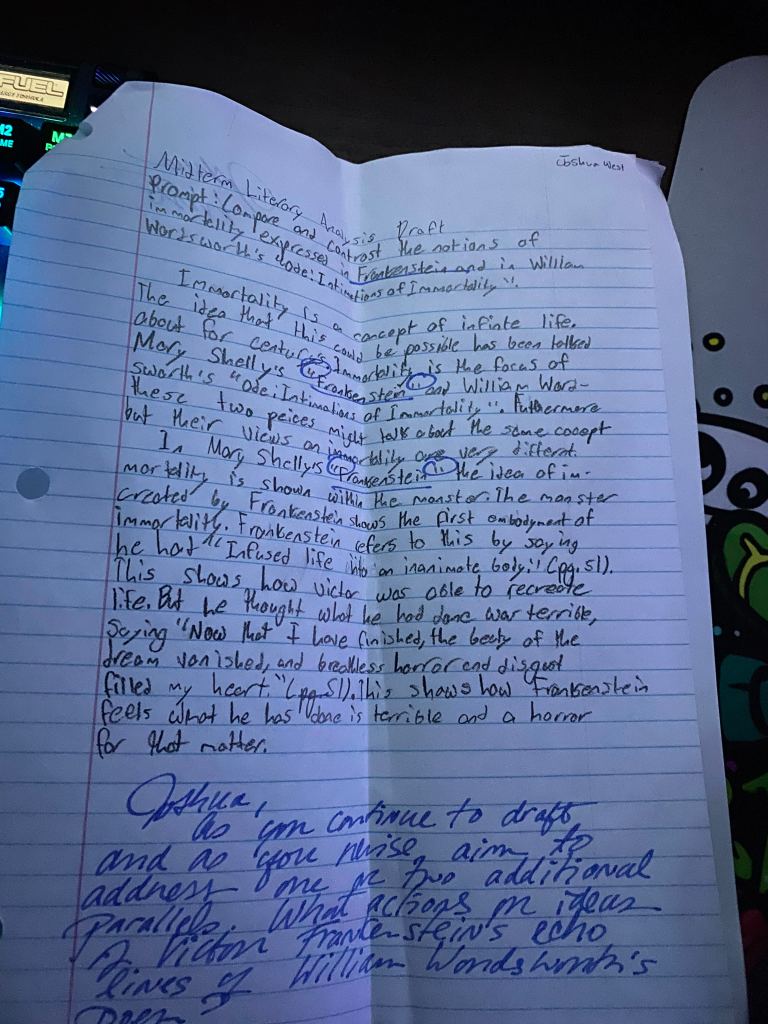
Immortality has been fantasized since the dawn of time. Mary Shellys Frankenstein and William Wordsworth’s “Ode: Intimations of Immortality” both do a superb job of addressing and discussing immortality. Frankenstein offers a crude solution to infinite life by the creation of the monster. Meanwhile “Ode: Intimations of Immortality” offers a more peaceful sentiment by expressing that life on earth is a simpler part of a much more pure existence which is forgotten through the process of aging. These two ideas of immortality are vastly different and contrast heavily while still maintaining small similarities.
Wordsworth’s words in “Our birth is but a sleep and a forgetting” (Line 59), presents the idea that birth is a shadow of a past life, and that we as humans dwell on the past place that we live but through aging we are slowly overwhelmed by our surroundings so that we forget all about it. “But trailing clouds of glory do we come From God, who is our home: Heaven lies about us in our infancy!” (Line 65-68) expresses that this past place we remember in infancy is truly the glorious palace of Heaven. To keep the balance of mortality, Wordsworth references that a worldly being “hath kept watch o’er man’s mortality” (Line 203), showing that a worldly being or a God is watching over mortality and creating immortality.
The monster is the main focus of Mary Shellys Frankenstein. Victor Frankenstein, the scientist behind the monster, was on the pursuit of immortality or to “bestow animation upon lifeless matter” (Shelley 52). He was in pursuit of a holy or sentient being but what he ended up creating was an ungodly monster. Furthermore, Victor sought to achieve immortality by “renew lifewhere death had apparently devoted the body to corruption.” (Shelley 52). This presents the notation that immortality in merely taking what is deceased and making it come back to life. In a sense, Victor was trying to achieve re-birth and wanted to imitate God.
The notions of immortality in Mary Shellys Frankenstein and William Wordsworth’s “Ode: Intimations of Immortality” are vastly different but have one very large similarity. Frankenstein presents immortality as the “renew life where death had apparently devoted the body to corruption.” (Shelley 52). Meanwhile “Ode: Intimations of Immortality” presents immortality through the idea that humans are reborn from heaven and slowly as a person develops, they forget their memories of heaven. These two have one thing in common and that is the religious factor. In Frankenstein Victor wanted to create a godly being; and Wordsworth implies that we are reborn by a godly being though saying we are reborn from heaven.
In summary, both Mary Shellys Frankenstein and William Wordsworth’s “Ode: Intimations of Immortality” have a large focus on immortality. Each presents a vastly different notation of immortality and a vastly different method of obtaining immortality. Although they have vastly different notations and ways of obtaining immortality, they both have hints of religion and of other worldly beings.
Works Cited
Shelly, Mary. Frankenstein. Introduction and Notes by Karen Kargiener. Barnes and Noble,
2003.
Wordsworth, William. “Ode: Intimations of Immortality.” The Norton Anthology of British
Literature: The Romantic Period. 10th ed. Stephan Greenblatt, General Editor. W.W.
Norton,2017. Pp. 347-52.
Immortality has been fantasized since the dawn of time. Mary Shellys Frankenstein and William Wordsworth’s “Ode: Intimations of Immortality” both do a superb job of addressing and discussing immortality. Frankenstein offers a crude solution to infinite life by the creation of the monster. Meanwhile “Ode: Intimations of Immortality” offers a more peaceful sentiment by expressing that life on earth is a simpler part of a much more pure existence which is forgotten through the process of aging. These two ideas of immortality are vastly different and contrast heavily while still maintaining small similarities.
Wordsworth’s words in “Our birth is but a sleep and a forgetting” (Line 59), presents the idea that birth is a shadow of a past life, and that we as humans dwell on the past place that we live but through aging we are slowly overwhelmed by our surroundings so that we forget all about it. “But trailing clouds of glory do we come From God, who is our home: Heaven lies about us in our infancy!” (Line 65-68) expresses that this past place we remember in infancy is truly the glorious palace of Heaven. To keep the balance of mortality, Wordsworth references that a worldly being “hath kept watch o’er man’s mortality” (Line 203), showing that a worldly being or a God is watching over mortality and creating immortality.
The monster is the main focus of Mary Shellys Frankenstein. Victor Frankenstein, the scientist behind the monster, was on the pursuit of immortality or to “bestow animation upon lifeless matter” (Shelley 52). He was in pursuit of a holy or sentient being but what he ended up creating was an ungodly monster. Furthermore, Victor sought to achieve immortality by “renew lifewhere death had apparently devoted the body to corruption.” (Shelley 52). This presents the notation that immortality in merely taking what is deceased and making it come back to life. In a sense, Victor was trying to achieve re-birth and wanted to imitate God.
The notions of immortality in Mary Shellys Frankenstein and William Wordsworth’s “Ode: Intimations of Immortality” are vastly different but have one very large similarity. Frankenstein presents immortality as the “renew life where death had apparently devoted the body to corruption.” (Shelley 52). Meanwhile “Ode: Intimations of Immortality” presents immortality through the idea that humans are reborn from heaven and slowly as a person develops, they forget their memories of heaven. These two have one thing in common and that is the religious factor. In Frankenstein Victor wanted to create a godly being; and Wordsworth implies that we are reborn by a godly being though saying we are reborn from heaven.
In summary, both Mary Shellys Frankenstein and William Wordsworth’s “Ode: Intimations of Immortality” have a large focus on immortality. Each presents a vastly different notation of immortality and a vastly different method of obtaining immortality. Although they have vastly different notations and ways of obtaining immortality, they both have hints of religion and of other worldly beings.
Works Cited
Shelly, Mary. Frankenstein. Introduction and Notes by Karen Kargiener. Barnes and Noble,
2003.
Wordsworth, William. “Ode: Intimations of Immortality.” The Norton Anthology of British
Literature: The Romantic Period. 10th ed. Stephan Greenblatt, General Editor. W.W.
Norton,2017. Pp. 347-52.
 Joshua West
Joshua, “The Re-Do that is Immortality” presents a well-wrought and insightful comparative study of the theme of immortality in Mary Shelley’s Frankenstein and William Wordsworth’s Ode: Intimations on Immortality.” Developing your conclusion and correcting minor errors of mechanics and style would make this strong essay even stronger.
LikeLike