Alice’s Adventures in Isolation

Cole Harris, Luke Noble, Joshua West

Preface

Alice’s Adventures in Wonderland is a novel written by Lewis Carroll and was published on November 26th in 1865. Alice is sitting on a riverbank with her sister looking over her shoulder at the book her sister is reading. The next thing Alice sees is a white rabbit with a waistcoat on running by her looking at a pocket watch and says that he is late. Alice follows the rabbit and jumps down the rabbit hole, this leads her to a big hallway that is lined with doors. Alice is then too big to fit through some of the doors and she figures out she can grow and shrink by eating different things. After several interactions with other animals, Alice runs into a caterpillar that gives her a mushroom that lets her shrink and grow by eating different parts of it. Eventually, Alice runs into the Queen of Hearts and plays a strange game of croquet. The queen starts calling for other players to be executed showing off her madness. Alice is then in the trial of the Knave of Hearts for stealing the Queen’s tarts; Alice is then called to the witness stand while the King begins to read a poem that he misinterprets the admission of guilt by the Knave. Alice protests the King’s interpretation. Alice and the Queen start to argue so the Queen then yells as loud as she can “Off with her head”(Carroll ch. 12). Alice then grows to a huge size and fights off the Queen’s army. The next thing Alice knows is that she has awakened on her sister’s lap. They both go inside to have tea while Alice tells her sister about her dream. 

Alice’s Adventures in Isolation

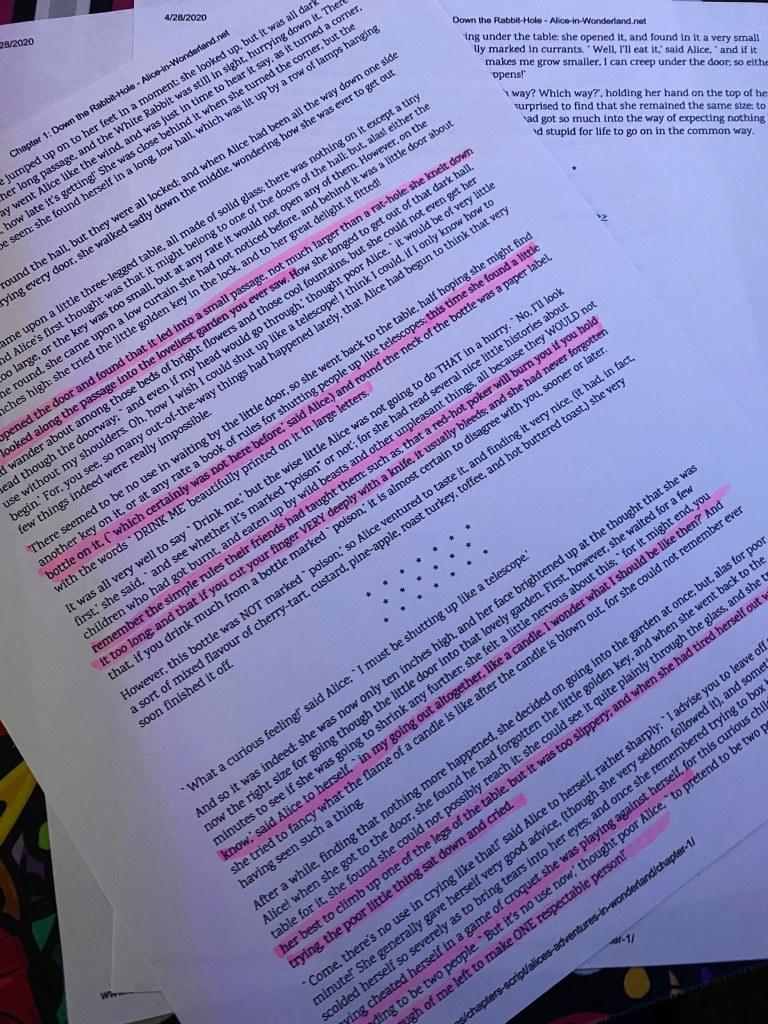
I saw the rabbit and jumped down the hole and now there is no one around me, just a big hallway with doors everywhere. I’m scared and lonely not knowing what I got myself into. There is a bottle that says “drink me” so somebody had to be around since it was not there before. I thought to myself was it the rabbit that put it there. After drinking it I started to shrink up. After struggling with the doors and the key I found this box with a cake in it that said “eat me”. I have a feeling it’s that rabbit messing with me. I ate the cake and grew to a humongous size. There was no one around me and I could not get through these doors, but it was hopeless I sat down and began to cry. I was desperate for someone to just show up out of nowhere and help me, but I am stuck in this isolation that I did not want. 

Stuck inside of this isolation I continued to venture. I started to venture with a group of animals. A very wise mouse starts to tell me a history lesson. One of the animals I was venturing with proposed a “cactus race”. After a while, the cactus race ended and I gave mints to all of the animals as a reward. The mouse I was traveling with started to tell another tale. I was more focused on other things and because of this the mouse got mad. He left, which causes the rest of the animals I was traveling with to be sad. As I was talking to the animals about my cat back at home, I mentioned a funny story about how she kills birds. Out of fear all of the animals run away from me. I am all alone again with tears inside my eyes. 

The rabbit returned once again, I was very eager to see him. He was muttering to himself, I believe because he had lost something. He did not notice me at first, but then became quite angry upon noticing my presence. He told me to leave and bring him a pair of gloves and a fan. I was frightened and ran away. Whilst retrieving the items the rabbit requested I stumbled upon a small bottle with the words “Drink me” written on it. I put it to my lips and drank, knowing something was bound to happen. I began growing and growing, to the point where I could no longer fit inside the room. I had to stick one of my arms out the window and my leg up the chimney. I am tired of growing smaller and larger, I wish I had never gone down the rabbit hole. The rabbit soon arrived at the house and tried coming into the bedroom. I would not let him out of fear, even though I was now a thousand times his size. The rabbit tried to send Bill down the chimney, but I kicked him across the yard and into the hedges. I saw some little cakes on the floor and decided to eat one in hopes that it would make me smaller. It did! I escaped out the window and into the woods, where I tried to figure out how to return to my normal size. I found a puppy in the woods and began to play with it. I then ran off until I became too exhausted to go any further. I decided it was time for me to rest.

Works Cited

Carroll, Lewis. Alice’s Adventures in Wonderland. 1865. Project Gutenberg, 

http://www.gutenberg.org/files/11/11-h/11-h.htm. Accessed 27 Apr. 2020.
The Re-Do That is Immortality

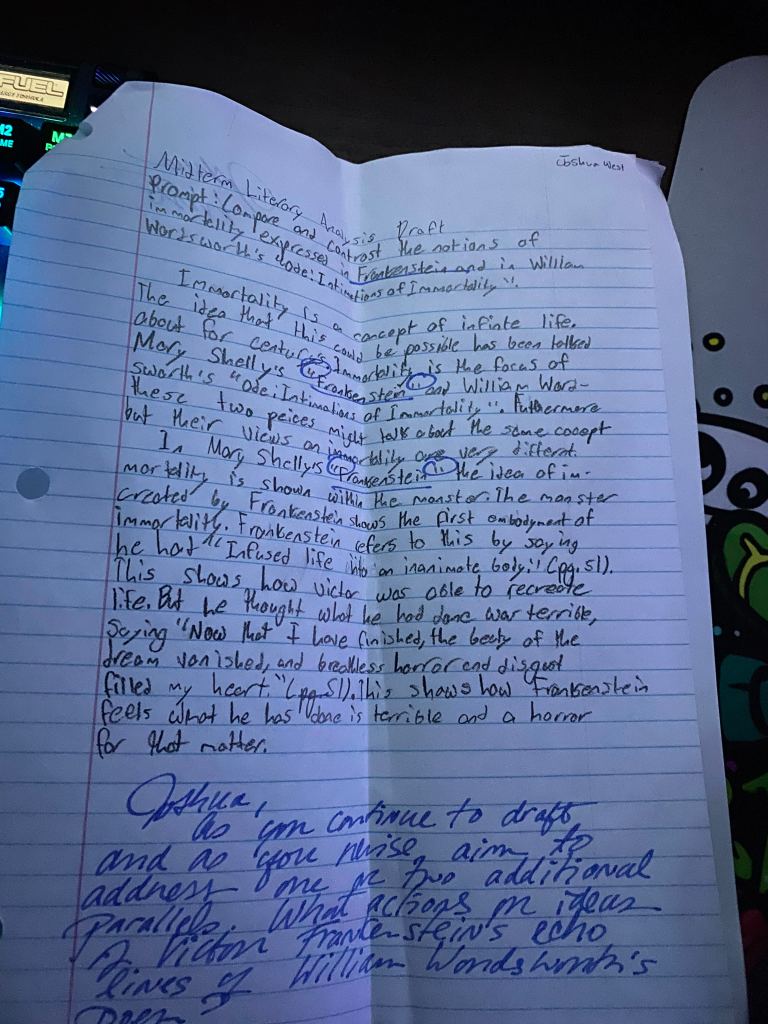
Immortality has been fantasized since the dawn of time.  Mary Shellys Frankenstein and William Wordsworth’s “Ode: Intimations of Immortality” both do a superb job of addressing and discussing immortality. Frankenstein offers a crude solution to infinite life by the creation of the monster. Meanwhile “Ode: Intimations of Immortality” offers a more peaceful sentiment by expressing that life on earth is a simpler part of a much more pure existence which is forgotten through the process of aging. These two ideas of immortality are vastly different and contrast heavily while still maintaining small similarities. 

Wordsworth’s words in “Our birth is but a sleep and a forgetting” (Line 59), presents the  idea that birth is a shadow of a past life, and that we as humans dwell on the past place that we live but through aging we are slowly overwhelmed by our surroundings so that we forget all about it. “But trailing clouds of glory do we come From God, who is our home: Heaven lies about us in our infancy!” (Line 65-68) expresses that this past place we remember in infancy is truly the glorious palace of Heaven. To keep the balance of mortality, Wordsworth references that a worldly being “hath kept watch o’er man’s mortality” (Line 203), showing that a worldly being or a God is watching over mortality and creating immortality. 

The monster is the main focus of Mary Shellys Frankenstein. Victor Frankenstein, the scientist behind the monster, was on the pursuit of immortality or to “b​estow animation upon lifeless matter” (Shelley 52). He was in pursuit of a holy or sentient being but what he ended up creating was an ungodly monster. Furthermore, Victor sought to achieve immortality by “r​enew life​where death had apparently devoted the body to corruption.” (Shelley 52). This presents the notation that immortality in merely taking what is deceased and making it come back to life. In a sense, Victor was trying to achieve re-birth and wanted to imitate God. 

The notions of  immortality in Mary Shellys Frankenstein and William Wordsworth’s “Ode: Intimations of Immortality” are vastly different but have one very large similarity. Frankenstein presents immortality as  the “r​enew life​ where death had apparently devoted the body to corruption.” (Shelley 52). Meanwhile “Ode: Intimations of Immortality” presents immortality through the idea that humans are reborn from heaven and slowly as a person develops, they forget their memories of heaven. These two have one thing in common and that is the religious factor. In Frankenstein Victor wanted to create a godly being; and Wordsworth implies that we are reborn by a godly being though saying we are reborn from heaven. 

In summary, both Mary Shellys Frankenstein and William Wordsworth’s “Ode: Intimations of Immortality” have a large focus on immortality. Each presents a vastly different notation of immortality and a vastly different method of obtaining immortality. Although they have vastly different notations and ways of obtaining immortality, they both have hints of religion and of other worldly beings. 

Works Cited

Shelly, Mary. Frankenstein. Introduction and Notes by Karen Kargiener. Barnes and Noble, 

2003.

Wordsworth, William. “Ode: Intimations of Immortality.” The Norton Anthology of British

 Literature: The Romantic Period. 10th ed. Stephan Greenblatt, General Editor. W.W. 

Norton,2017. Pp. 347-52.

Immortality has been fantasized since the dawn of time.  Mary Shellys Frankenstein and William Wordsworth’s “Ode: Intimations of Immortality” both do a superb job of addressing and discussing immortality. Frankenstein offers a crude solution to infinite life by the creation of the monster. Meanwhile “Ode: Intimations of Immortality” offers a more peaceful sentiment by expressing that life on earth is a simpler part of a much more pure existence which is forgotten through the process of aging. These two ideas of immortality are vastly different and contrast heavily while still maintaining small similarities. 

Wordsworth’s words in “Our birth is but a sleep and a forgetting” (Line 59), presents the  idea that birth is a shadow of a past life, and that we as humans dwell on the past place that we live but through aging we are slowly overwhelmed by our surroundings so that we forget all about it. “But trailing clouds of glory do we come From God, who is our home: Heaven lies about us in our infancy!” (Line 65-68) expresses that this past place we remember in infancy is truly the glorious palace of Heaven. To keep the balance of mortality, Wordsworth references that a worldly being “hath kept watch o’er man’s mortality” (Line 203), showing that a worldly being or a God is watching over mortality and creating immortality. 

The monster is the main focus of Mary Shellys Frankenstein. Victor Frankenstein, the scientist behind the monster, was on the pursuit of immortality or to “b​estow animation upon lifeless matter” (Shelley 52). He was in pursuit of a holy or sentient being but what he ended up creating was an ungodly monster. Furthermore, Victor sought to achieve immortality by “r​enew life​where death had apparently devoted the body to corruption.” (Shelley 52). This presents the notation that immortality in merely taking what is deceased and making it come back to life. In a sense, Victor was trying to achieve re-birth and wanted to imitate God. 

The notions of  immortality in Mary Shellys Frankenstein and William Wordsworth’s “Ode: Intimations of Immortality” are vastly different but have one very large similarity. Frankenstein presents immortality as  the “r​enew life​ where death had apparently devoted the body to corruption.” (Shelley 52). Meanwhile “Ode: Intimations of Immortality” presents immortality through the idea that humans are reborn from heaven and slowly as a person develops, they forget their memories of heaven. These two have one thing in common and that is the religious factor. In Frankenstein Victor wanted to create a godly being; and Wordsworth implies that we are reborn by a godly being though saying we are reborn from heaven. 

In summary, both Mary Shellys Frankenstein and William Wordsworth’s “Ode: Intimations of Immortality” have a large focus on immortality. Each presents a vastly different notation of immortality and a vastly different method of obtaining immortality. Although they have vastly different notations and ways of obtaining immortality, they both have hints of religion and of other worldly beings. 

Works Cited

Shelly, Mary. Frankenstein. Introduction and Notes by Karen Kargiener. Barnes and Noble, 

2003.

Wordsworth, William. “Ode: Intimations of Immortality.” The Norton Anthology of British

 Literature: The Romantic Period. 10th ed. Stephan Greenblatt, General Editor. W.W. 

Norton,2017. Pp. 347-52.

The Sorrow

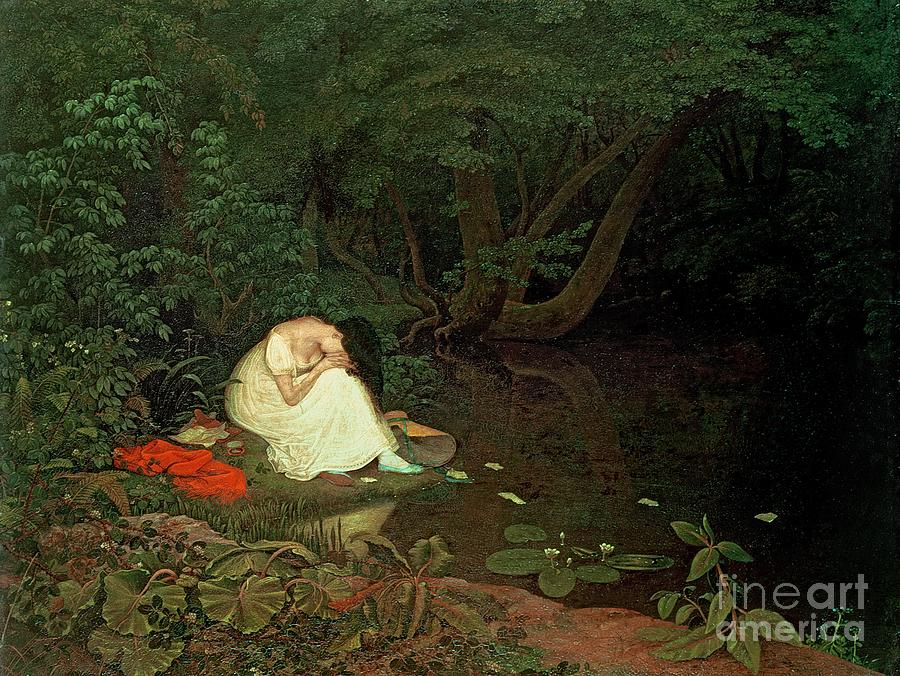
Disappointed Love is a piece, at first glance, you can feel the emotions pouring out. It depicts a Lady sitting down crying in a white dress on the ground near what appears to be a pond or a river. In the background, we see some greenery and oddly curved trees. Laying next to the crying Lady is what appears to be a hat and a red jacket or cover The white dress and the crying indicates some sort of important event went wrong like a wedding. This makes the imagine more like the title of the peace Disappointed Love.

This piece can be related back to Frankenstein by time period, because it shows the sorrow that was trending during the Romantic Period. The same sadness and sorrow that Mary Shelly the author of Frankenstein highlights within her writing in Stein’s background. Furthermore Mary Shelly’s life story is filled with the exact same sorrow, with a lot of her family members dying at a young age.

Image result for disappointed love francis danby

Works Cited

Danby, Francis. Disappointed Love. The Norton Anthology of Birtish Literature: The Romantic Period. 10th ed. General Editor. W. W. Norton, 2017

Shelley, Mary. Frankenstein. Introduction and Notes by Karen Karbiener. Barnes and Noble, 2003.

Design a site like this with WordPress.com
Get started